"Nothing About Us Without Us"
For decades, the global tech and medical industries have operated on a 'charity' or 'medical' model. In this outdated framework, disabled individuals are viewed as passive recipients of care—people whose bodies need to be 'fixed' or accommodated by able-bodied experts.
Rejecting the Charity Model
Technologies are routinely designed for disabled people by engineers who have never lived their reality, resulting in tools that look impressive in a lab but fail completely in the real world.
Traditional Approach
Designing for disabled people without their input
Our Approach
Designing with the community as equal partners
Our project definitively rejects this approach. We operate on the principles of Emancipatory Disability Research and the foundational disability rights mandate: "Nothing About Us Without Us".
To build an AI system that is genuinely safe, effective, and respectful, we knew we had to fundamentally change who holds the power in the design process.
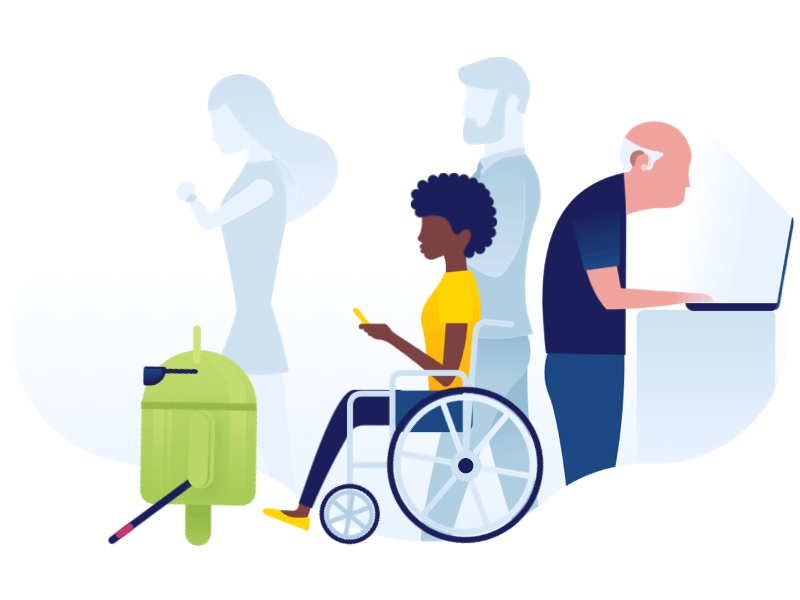 Designing FOR
The Diverse Disability User Committee
To drive this initiative, we established the Diverse Disability User Committee—a dedicated Makerere University cohort comprising Deaf students, veteran sign language interpreters, and healthcare administrators.
This committee is not a symbolic focus group or a passive advisory board to be consulted at the end of the project. They are an operational governing body embedded directly into the AI's development. By placing them at the helm, we ground our entire methodology in two core concepts:
Deaf Student Representative
Bringing lived experience of navigating healthcare
Veteran Sign Language Interpreter
Bridging clinical and sign language expertise

Healthcare Administrator
Ensuring clinical protocol alignment
Epistemic Authority: The True Experts of the Body
In traditional healthcare and technology, bias often invalidates the knowledge of marginalized people, assuming that only doctors or software engineers hold "true" expertise. We reject this.
We center the concept of Epistemic Authority—the profound recognition that the Deaf community are the absolute experts, and the "primary knowers," of their own bodies, barriers, and communication needs. When a Deaf patient navigates a speech-locked clinic, their lived experience is not an "anecdotal story." It is highly specialized domain expertise and high-value clinical data.
Shifting Power: From "Research On" to "Research With"
Research "On"
Historically, vulnerable populations have been subjected to extractive "research on" them—where their data is harvested to build models that serve institutional agendas.
Research "With"
Our Co-Creation Futures pipeline shifts this dynamic entirely to "research with" the community. This means distributing real, structural power.
We grant the Diverse Disability User Committee absolute veto power over the AI's design, protocols, and data practices.
Defining Success: The community decides what "success" and "harm" look like. If the AI is technically fast but makes them feel publicly exposed or stigmatized, it is deemed a failure.
The Power to Say No: The committee has the authority to veto inaccessible hardware (like demanding privacy screens instead of mounted cameras) and dictate strict rules on what data should never be collected or stored to prevent surveillance.
Architects of Access: Through this power-sharing, the Deaf participants transition from being passive objects of medical care to active architects of their own inclusive futures.
By embedding Emancipatory Disability Research into the core of our AI architecture, we prove that true technological innovation doesn't just process data—it dismantles systemic oppression.
Ready to see our methodology in action?
Explore how we map reality and stress-test our AI through community co-creation.